The World Cup
I walked over to the meadow because I am feeling restless. Earlier in the day, I met someone whose work I admired. We ended our meeting with an idea to collaborate on something I've been thinking of for a while, but it only heightened my recent feeling of being adrift, behind a curve. Her accomplishments reminded me how much of my professional life I've wasted following stupid men's directions. I was already feeling rootless, anyway: my visa application was rejected and I can't leave the island until it's resolved, but my love is off the island, two weeks into a long trip that's not half over yet. I'm wondering how the precarity of going from shitty visa to shitty visa has limited my imagination, how the uncertainty of belonging inhibits boldness, all this administrative hassle because 8 years ago I ran away for a do-over after some poor early-adult life decisions.
So I close my laptop, leave my phone on the table, lock the door behind me. I step around piles of smashed glass - so much of it, the jagged confetti of English celebration - and cut through the estate that faces the dusty lot with the warehouse three stories tall, an open-faced shell of corrugated metal, receiving dumps of demolition leftovers, the rubble of whatever had been removed hauled away in skips for something more expensive to take its place. The view inside the lot is mostly blocked thanks to the layer of fire-resistant tarping stretched above the brick wall, held fast with skinny posts. Last month, another warehouse on the other side of the train tracks, the recycling centre where the Council sends mattresses collected from the street, caught fire. It burned through the night, leaving a thick noxious haze that burned our eyes and settled in side streets the wind avoided.
Despite the blocked view, I always try to peer in, perversely fascinated by the mess and the shameful nostalgia it sparks. It looks like another warehouse I once spent some time in, a kind of waiting room for collected items beside an incinerator that was gradually cannibalising the military base it sat in, burning piles of plywood that had once been shelters, reducing surplus food to ash, turning the everyday personal affects of US Marines to smoke as they prepared to abandon their posts and head home, following the orders of Generals who knew what would happen as soon as the Americans left Afghanistan.
In one of the smaller car parks with a few spaces near the edge of the estate, two vans missing most of their tires sit hopelessly, several of their windows reduced to even more piles of glass on the ground. I take a little uphill path worn in the dirt between the trees and come out onto the southeastern corner of the meadow. The northernmost part of it has a modest hill - a mound, really - with a view of all the central skyscrapers that, if you can forget what they're for, look beautiful as prisms for the softening evening light in this summer's third heat wave. The western edge of the meadow is bordered by a paved path, the Overground rumbling by every few minutes on the other side of a fence.
I learned from my trip here last week and came prepared this time. I take out the small tupperware from my backpack and fill it with blackberries. Last week, I only had a bandana as a makeshift basket, the berries leaving purple smudges on the paisley. Thorny branches catch at my patchwork trousers, the purple ones I bought from the Nigerian auntie on Deptford High Street who sewed them from scraps from her other projects. As I pick berries, a teenaged couple linger near the clearing I came in from. I congratulate the boy with his football shoved under his shirt, wish him and the baby well. He lovingly rubs his ball-belly and thanks me. "See?" He turns to the girl beside him, who looks both amused and embarrassed. "Someone appreciates it."
I fill the tupperware, and my mouth, with blackberries and spread my blanket out not far from where I just finished picking. The hill blocks the view of the skyscrapers - only the pointy top of the Shard is visible, but my 360-view is still filled with cranes. One of the new builds in South Bermondsey has a rooftop garden decorated with string lights, from which you could probably see down into the St James Estate, where two months ago residents founded a tenants association after their new corporate landlord tried to evict them. They hadn't even been notified their estate had been sold.
I underestimated how long the heat would persist and take off my trousers. There aren't many people here, but most of them are kicking footballs. The young man I see here sometimes, always practicing, always dressed in a black tank top, black shorts, headphones, is in his usual spot along the meadow's eastern edge. With gentle, precise kicks, he keeps the ball off the ground in long volleys with himself. At the base of the hill, in the centre of the meadow, a mother stands in a triangle with her two young children, barely old enough to balance, taking their first aims at a tinier ball scaled to their size. Further down the edge of blackberries are two women with two children.
I've seen these four here before, sitting in the same spot. The older woman, her mint green dress contrasting the red flowers on her khimar, summons the younger child, a girl of maybe 4 or 5, to take a lap around the meadow. The girl is wearing a floaty pink dress with flowers and kicks a hot pink football in front of her. She looks like a little fairy. I give her a little cheer as she passes in front of me. She pauses, smiles, kicks the ball again. The older woman takes a measured leisurely pace, the little girl flits behind on shorter legs.
The other woman starts strolling along the row of blackberry bushes, picking them, giving a quick burst of air over each before eating them. She is younger, dressed in all black. When she gets closer to me, I recommend she not pick the berries so close to the ground. She stares at me for a moment. Her loose headscarf has slipped off her head, and she leaves it hanging down her back like a hood. "No English." I pull on my trousers and walk over to meet her. I point to the low-hanging fruit and signal No, not these ones. She looks confused, so I pantomime pissing like a man, with sound effects, pretending to spray from the hips all over the bushes, then lift up my leg and pretend to be a dog doing the same. I point to the higher berries, well clear of waist height, and signal an enthusiastic yes. She nods and I go back to my blanket. She picks some more berries, then heads back to hers. A ginger cat pokes its head out from the bushes and looks around before disappearing back into the thicket, probably to pee.
The young man dressed in black has finished his practice and is heading home. He pushes an electric scooter and replaces his tight, surgical kicks with longer lobs across the meadow, catching up the ball as he walks. The older child in the family of four, an adolescent boy, intercepts one of these lobs, kicks it back to him, runs over to the young man and admires the scooter. They share a fist bump. A few minutes later, I hear the dried-out grass crunching around me. The woman in black and the two children head in my direction. The older woman hangs further back.
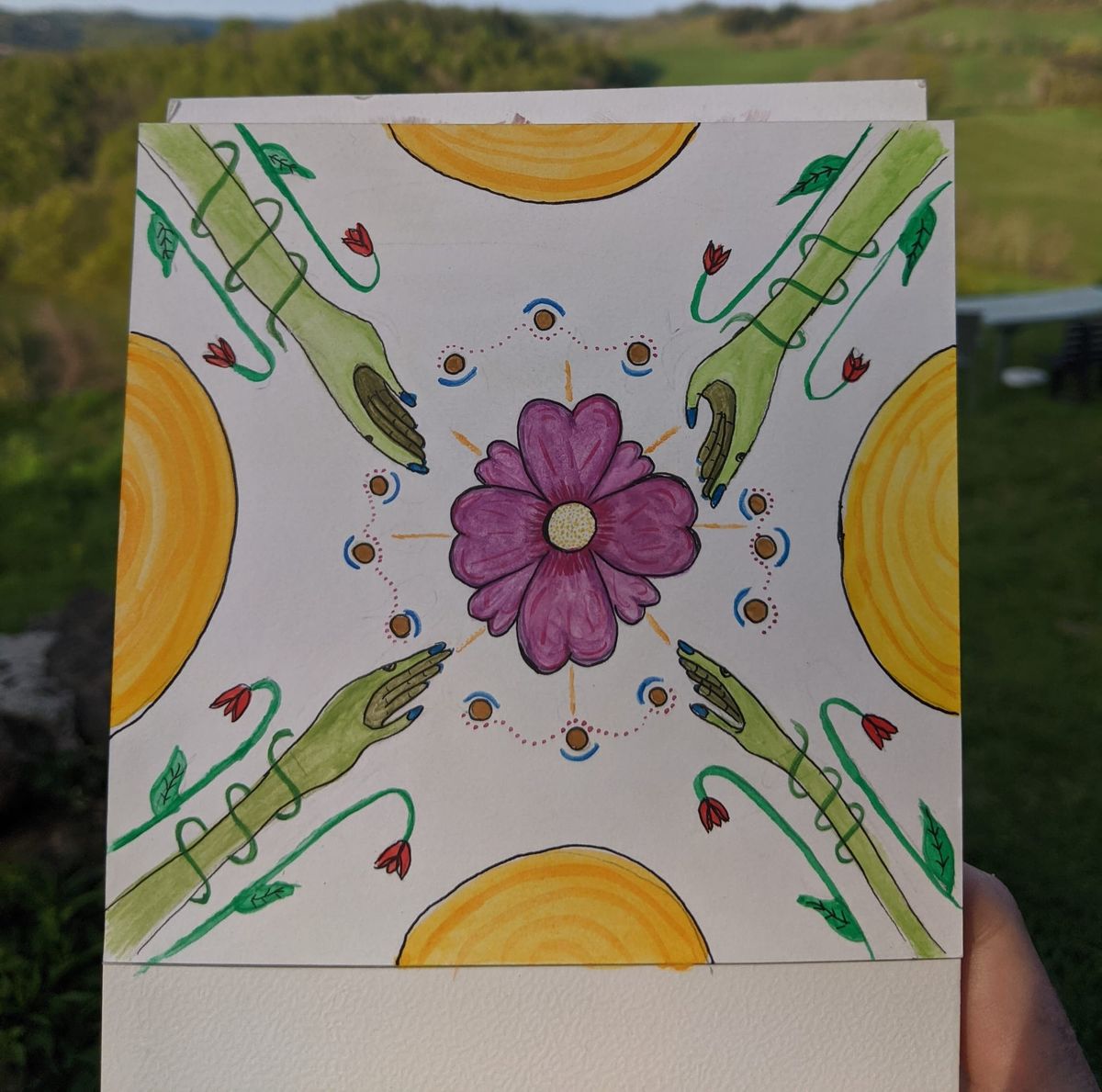
We greet each other. The boy crouches, fascinated by my art supplies. He touches each watercolour as if they're buttons. I show them some of my paintings, and the boy says "Good!" His favourite is one of my favourites, too: an attempt at symmetry, a tile-like painting I did at my love's friend's house in the south of France a few months ago. The friend's 10 year-old daughter liked making them, the pattern a helpful starting point when daunted by a blank sheet. He picks up my pens, the brushes, a curious "ooo" at at each item. I offer him some paper to try them out, but the woman in black smiles and shakes her head.
The little girl squats on her haunches so we are eye-level and gives me two thumbs up. The boy squats besides his sister and counts to ten in English, tells me that's what he is. He picks up the bright yellow paperback beside me, another "ooo."
"That's just my book," I tell him.
"Book?"
"Yep, a book."
This is a new word for him, and he says it three more times. I ask how to say it in his language, but the message doesn't get through. "No English," he says, as quickly as the woman had said it to me before. He stands back up, smiling. "Pashto." I ask where they're from. They all have the same sea-glass green eyes framed with dark lashes. I think I already know.
"Afghanistan," says the woman in black. Her scarf is still down around her shoulders.
"Oh!" For a moment, I'm at a loss for words. I wonder what they must have gone through but have a few guesses. I wish I could apologize without making it a whole thing, hope their neighbours are nice, that they won't feel too lonely, know other Afghans in London, can feel safe and at some point, maybe even rooted here. "Nice to meet you."
The little girl gives me another double thumbs up, and they turn back west to the path leading out of the meadow, kicking the hot pink ball ahead of them.